
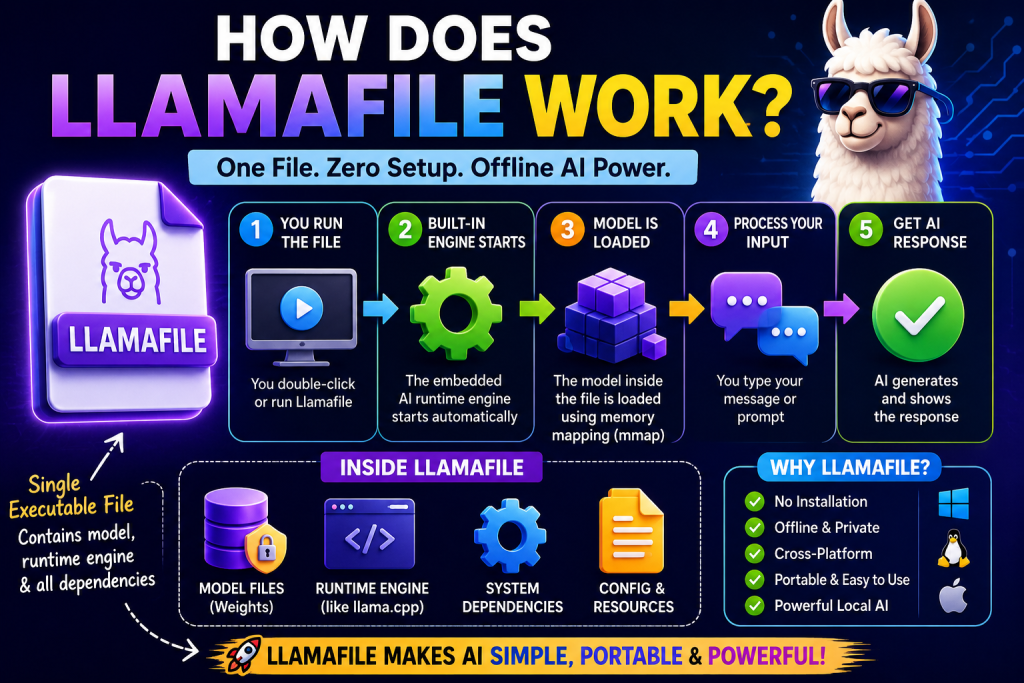
Llamafile is a new and innovative way to run large language models (LLMs) directly on your computer without complicated installation steps, cloud setup, or heavy configuration. Instead of downloading multiple files, setting up Python environments, or managing dependencies, Llamafile lets you run AI models using just a single executable file. This makes it extremely beginner-friendly and highly practical for developers, researchers, and everyday users who want offline AI access.
In simple terms, Llamafile combines an AI model and everything it needs to run into one portable file. You can double-click it like a normal app and start chatting with an AI model instantly. This approach removes traditional barriers in AI usage and brings powerful language models closer to local devices. In this article, we will explore how Llamafile works, what makes it special, and why it is becoming popular for running offline AI models.
Read More: What is Llamafile?
What is Llamafile?
Llamafile is an open-source project that packages a large language model (like LLaMA-based models) into a single self-contained executable file. It is built on top of modern AI runtime systems and is designed to make local AI execution simple and portable.
Instead of relying on cloud APIs, Llamafile allows users to run models directly on their own hardware.
This means:
- No internet required after download
- No installation of Python or libraries
- No complex setup process
- One file = full AI system
This simplicity is what makes Llamafile different from traditional AI frameworks.
Core Idea Behind Llamafile
The main idea behind Llamafile is “everything in one file.”
Normally, running a large language model requires:
- Model weights (huge data files)
- Runtime engine (like llama.cpp)
- System dependencies
- Configuration files
Llamafile combines all of these into a single portable executable. When you run it, it automatically extracts and uses everything internally without requiring manual setup.
This concept is inspired by self-extracting applications and modern portable software design.
How Does Llamafile Work Internally?
To understand how Llamafile works, we need to break it into a few simple steps:
Single Executable File Structure
A Llamafile is actually a special type of file that behaves like both:
- A normal executable program
- A compressed archive containing AI model data
This hybrid structure allows it to store large AI models inside the file while still being runnable like a standard application.
When you open it, your operating system treats it as a program and starts execution immediately.
Built-in AI Runtime Engine
Inside the Llamafile is a built-in inference engine, often based on optimized systems like llama.cpp.
This engine is responsible for:
- Loading the model
- Processing user input
- Generating responses
- Managing memory efficiently
Because the runtime is already included, users don’t need to install anything separately.
Memory Mapping for Speed
One of the most powerful techniques used in Llamafile is memory mapping (mmap).
Instead of fully loading the model into RAM, Llamafile:
- Maps the model file directly into system memory
- Loads only the required parts when needed
- Reduces RAM usage significantly
This makes it possible to run large models even on moderate hardware.
Automatic Model Extraction
When the file runs, Llamafile does not require manual unpacking. Instead, it:
- Detects embedded model data
- Loads it dynamically in the background
- Prepares the inference engine automatically
This process happens instantly, giving the impression of a simple app launch.
Cross-Platform Execution
Llamafile is designed to work across multiple operating systems:
- Windows
- Linux
- macOS
It uses platform-aware execution layers so the same file can run on different systems without modification. This makes it highly portable.
Why Llamafile is Different from Traditional AI Tools
Traditional AI systems require setup steps that can be difficult for beginners.
For example:
- Installing Python
- Setting up virtual environments
- Downloading dependencies
- Configuring GPU support
Llamafile removes all of this complexity.
Here is what makes it unique:
- Zero installation setup
- Offline AI usage
- Single-file distribution
- Fast local execution
- No API dependency
This makes it ideal for privacy-focused users and offline environments.
Key Features of Llamafile
Let’s look at the most important features that define how Llamafile works in real-world use:
Portable AI Models
You can move the file anywhere and run it instantly without installation.
Offline Functionality
Once downloaded, it works without internet access, making it perfect for secure environments.
Fast Startup
Since everything is bundled, there is no waiting for setup or dependency loading.
Lightweight Execution
Memory mapping ensures efficient use of system resources.
Developer Friendly
Developers can easily distribute AI models as simple downloadable files.
How to Use Llamafile (Simple Flow)
Using Llamafile is extremely simple compared to traditional AI tools:
- Download the Llamafile executable
- Make it runnable (if required on Linux/macOS)
- Double-click or run it from terminal
- Open the built-in interface or API
- Start chatting with the model
No setup, no configuration, no extra tools required.
Benefits of Llamafile for Users
Llamafile is not just a technical innovation; it also brings real benefits:
Better Privacy
Since everything runs locally, your data does not leave your device.
No Subscription Costs
You don’t need paid APIs or cloud services.
Offline Access Anywhere
It works even without internet connectivity.
Easy Distribution
Developers can share AI tools like normal software.
Technical Foundation Behind Llamafile
Llamafile is built using modern systems programming techniques and efficient model inference engines. One of its key foundations is integration with optimized LLM runtimes like llama.cpp, which allows it to run large language models efficiently on CPUs and GPUs.
It also uses compression and embedding techniques to ensure that large AI models can fit into a single distributable file without losing performance.
This combination of:
- Compression
- Memory mapping
- Embedded runtime
- Cross-platform execution
is what makes Llamafile so powerful and unique.
Limitations of Llamafile
Even though Llamafile is powerful, it does have some limitations:
- Large file sizes (because models are included)
- Performance depends on hardware
- Not ideal for very large enterprise-scale workloads
- Limited compared to cloud-based AI systems in some cases
However, for personal use and development, it is extremely effective.
Future of Llamafile Technology
The concept behind Llamafile represents a major shift in AI distribution.
Instead of relying on centralized cloud APIs, more AI tools may move toward:
- Offline-first AI applications
- Portable model executables
- Privacy-focused local inference
As hardware becomes more powerful, tools like Llamafile will likely become more common for everyday AI usage.
Conclusion
Llamafile works by combining a large language model, runtime engine, and all dependencies into a single portable executable file. It uses advanced techniques like memory mapping, embedded runtimes, and cross-platform execution to make AI models easy to run on any system.
Its biggest strength is simplicity—just download, run, and start using AI without any setup. This makes it a powerful solution for developers, researchers, and users who want offline, private, and fast AI access.As AI technology continues to evolve, Llamafile represents an important step toward making powerful language models more accessible to everyone.