Llamafile is becoming a popular way to run powerful AI models locally without complex setup or cloud dependency. It allows users to download and run large language models in a single executable file, making AI more accessible for developers, researchers, and everyday users. One of the most important questions people ask is: what AI models are compatible with Llamafile?
The good news is that Llamafile supports a wide range of modern open-source models, especially those built on the GGUF format. In this article, we will explore compatible AI models, their categories, and how they work with Llamafile in a simple and user-friendly way.
Read More: Which Operating Systems Support Llamafile?
Understanding Llamafile Compatibility
Llamafile is designed to work with models that follow the GGUF (GPT-Generated Unified Format) standard. This format is commonly used in modern AI ecosystems, especially with tools like llama.cpp.
In simple words, if an AI model can be converted into GGUF format, it can usually run inside a Llamafile environment.
Key compatibility requirements include:
- Models must support GGUF format
- Models should be optimized for CPU or GPU inference
- Quantized versions (like 4-bit or 8-bit) work best
- Open-source architecture is preferred
This makes Llamafile flexible and powerful for running AI locally without internet dependency.
Popular AI Model Families Compatible with Llamafile
Many well-known AI model families are compatible with Llamafile. These models are widely used in natural language processing, coding assistance, chatbots, and research tasks.
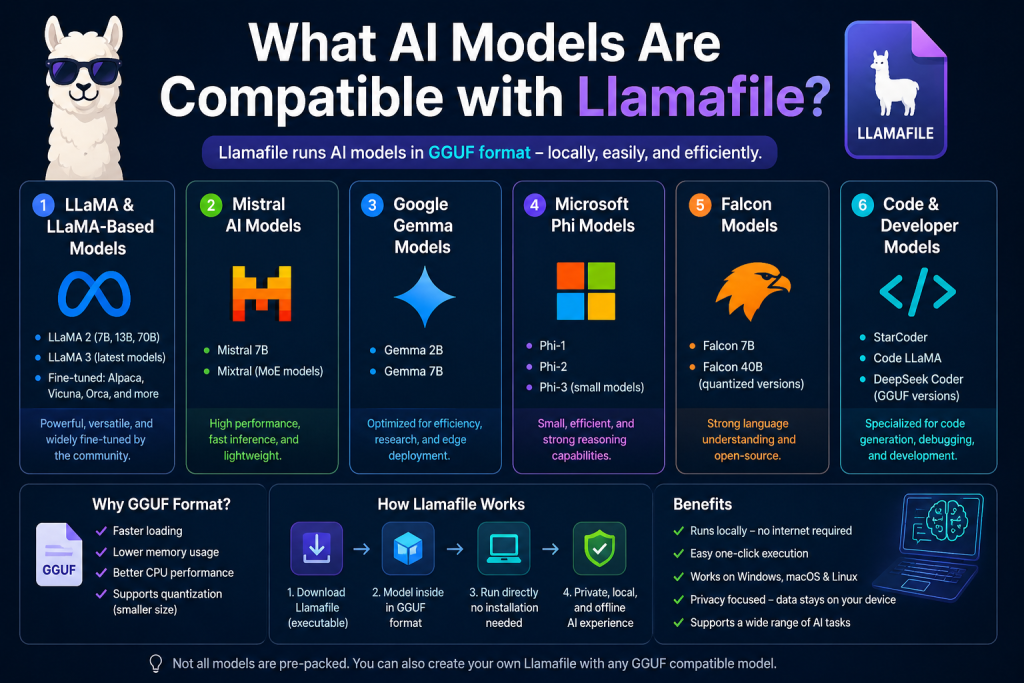
LLaMA and LLaMA-Based Models
One of the most important compatible model families is LLaMA (Large Language Model Meta AI) developed by Meta.
Compatible versions include:
- LLaMA 2 (7B, 13B, 70B)
- LLaMA 3 (latest open models)
- Fine-tuned versions like Alpaca, Vicuna, and Orca
These models are widely used because they are efficient and perform well on consumer hardware when quantized.
Mistral AI Models
Mistral AI models are highly optimized and lightweight, making them ideal for Llamafile.
Popular compatible models:
- Mistral 7B
- Mixtral (Mixture of Experts models)
Why they work well:
- High performance on smaller hardware
- Faster inference speed
- Excellent for chat and coding tasks
Google Gemma Models
Google’s Gemma models are also compatible when converted to GGUF format.
Examples:
- Gemma 2B
- Gemma 7B
These models are designed for:
- Lightweight AI applications
- Research experiments
- Mobile and edge deployment
They run efficiently in Llamafile due to their optimized architecture.
Microsoft Phi Models
Microsoft’s Phi series is another strong set of models supported by Llamafile.
Compatible models:
- Phi-1
- Phi-2
- Phi-3 (small language models)
Advantages:
- Very small size
- High reasoning ability for their scale
- Ideal for low-end devices
These models are perfect for users who want AI on limited hardware.
Falcon Models
Falcon AI models developed by TII (Technology Innovation Institute) are also compatible.
Examples:
- Falcon 7B
- Falcon 40B (quantized versions)
They are known for:
- Strong language understanding
- Good performance in chat applications
- Open-source availability
StarCoder and Code Models
For developers, coding models are highly important. Llamafile supports several code-focused models.
Popular ones include:
- StarCoder
- Code LLaMA
- DeepSeek Coder (GGUF versions)
These models help with:
- Code generation
- Debugging
- Programming assistance
How Llamafile Supports These Models
Llamafile works by packaging AI models into a single executable file. This removes the need for complex installation steps.
Here’s how compatibility works in practice:
- Model is trained in original format (like Hugging Face format)
- It is converted into GGUF format
- Llamafile bundles the model into an executable
- User runs it directly without setup
This makes AI usage extremely simple, even for non-technical users.
Why GGUF Format Matters
GGUF is the backbone of Llamafile compatibility. Without it, most models would not run efficiently.
Benefits of GGUF:
- Faster loading speed
- Lower memory usage
- Better CPU performance
- Supports quantization (smaller file size)
Because of this format, even large models can run on laptops or mid-range PCs.
Hardware Compatibility of Models
Different models perform differently depending on your hardware.
Low-End Systems (4GB–8GB RAM)
Best models:
- Phi-2
- TinyLLaMA
- Small Mistral quantized versions
Mid-Range Systems (8GB–16GB RAM)
Best models:
- Mistral 7B
- Gemma 7B
- LLaMA 2 7B
High-End Systems (16GB+ RAM)
Best models:
- LLaMA 3 (13B or higher)
- Mixtral models
- Falcon 40B (quantized)
Advantages of Using Compatible Models in Llamafile
Using supported AI models inside Llamafile offers several benefits:
- No internet required after download
- Easy one-click execution
- Strong privacy (data stays local)
- Works across Windows, Linux, and macOS
- Supports wide range of AI tasks
This makes it ideal for developers, students, and AI enthusiasts.
Limitations to Consider
While compatibility is wide, there are still some limitations:
- Not all proprietary models are supported
- Very large models may run slowly on weak hardware
- Requires GGUF conversion for most models
- GPU acceleration may vary depending on system
Despite these limitations, Llamafile remains one of the easiest ways to run AI locally.
Future of Llamafile Model Compatibility
The ecosystem is growing quickly. In the future, we can expect:
- More optimized GGUF models
- Better GPU support
- Faster inference engines
- Wider support for multimodal models (text + image)
- Improved performance on low-end devices
As open-source AI continues to expand, Llamafile will likely support even more advanced models.
Conclusion
Llamafile supports a wide range of modern AI models, especially those built on open-source frameworks and GGUF format. Popular compatible models include LLaMA, Mistral, Gemma, Phi, Falcon, and several coding-focused models. This flexibility makes it a powerful tool for running AI locally without complex setup.
Whether you are a developer, student, or researcher, Llamafile provides an easy way to experiment with different AI models efficiently and privately. As the ecosystem continues to grow, compatibility will only improve, making local AI even more accessible for everyone.